


Enneagram Type 6 as a Business Owner

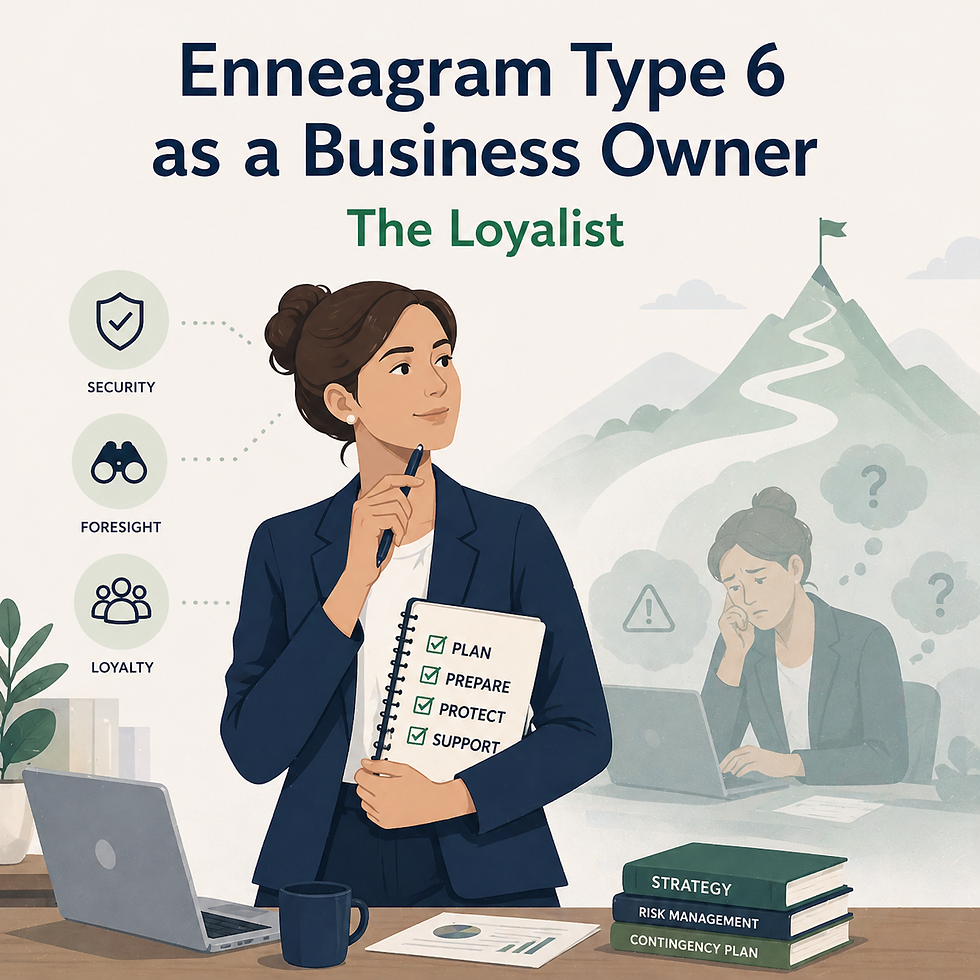
The Loyalist (or Loyal Skeptic) as Business Owner and Leader
Every business owner leads from their unique personality, whether they are aware of it or not. Personality frameworks, and in particular the Enneagram, help us understand the motivations and stress patterns that shape how we build and grow our organizations so we can make healthier, more informed decisions.
Type 6 leaders are often the stabilizers of their businesses. They bring foresight, loyalty, and a strong ability to anticipate challenges before they happen. They want to build something that is secure, prepared, and able to withstand uncertainty. But the same awareness that protects the business can also create internal strain.
Here’s how Type 6 shows up in business: at their best, under stress, and in growth.
Strengths of a Type 6 Business Owner
Type 6 business owners are natural risk managers.
They are constantly scanning for what could go wrong, not out of pessimism, but out of a deep desire to create safety and stability. Where others may overlook potential issues, Type 6s prepare for them.
Natural strengths include:
Anticipating problems before they arise
Strong loyalty to their team and organization
Commitment to follow-through and responsibility
Building contingency plans and backup systems
Asking important questions others may overlook
Type 6 leaders often build organizations that are resilient and well-prepared. Their teams benefit from their ability to think ahead and avoid preventable mistakes.
What they may not realize is that not everyone is constantly evaluating risk or thinking through worst-case scenarios. What feels like responsibility and preparedness to a Type 6 can sometimes feel like worry, hesitation, or lack of confidence to others.
When Strength Becomes Strain
Under stress, strengths intensify and can become liabilities that must be consciously managed.
Preparedness becomes overthinking.
Instead of helping them move forward, constant scenario planning can slow decision-making.
Awareness of risk becomes anxiety.
They may begin to see potential problems everywhere, even when things are stable.
Loyalty becomes dependence on external reassurance.
They may look to others for confirmation before making decisions, especially in high-pressure situations.
Questioning becomes doubt.
They may begin to second-guess their own judgment, even when they have strong instincts.
Responsibility becomes pressure.
They may feel like they are carrying the weight of keeping everything safe, stable, and under control.
Type 6 leaders often believe that if they can just think through every possible outcome, they will feel secure. Instead, the search for certainty can create more tension and indecision.
Stress Patterns
With prolonged stress, Type 6 leaders can become more anxious, more reactive, and more uncertain.
They may experience:
Persistent mental worry or looping thoughts
Difficulty making decisions
Seeking reassurance but not fully trusting it
Increased sensitivity to risk or uncertainty
Internally, it can feel like their mind will not turn off. They may feel responsible for anticipating everything that could go wrong.
Externally, teams may experience them as hesitant, overly cautious, or inconsistent. At times, they may alternate between seeking input and pushing back against it.
Under chronic strain, some Type 6 leaders oscillate between hesitation and urgency. They may delay decisions due to uncertainty and then act quickly once pressure builds, creating a reactive cycle.
Reactive Patterns
When triggered, Type 6’s core fear of being unsupported, unsafe, or unprepared rises to the surface.
In those moments, their response often centers around regaining a sense of certainty and control.
Common reactive behaviors include:
Becoming more skeptical or distrustful
Over-questioning decisions or plans
Pushing back against authority or advice
Reacting quickly to perceived threats
Becoming more rigid in their thinking
Some Type 6s move toward caution and withdrawal, while others move toward confrontation and assertiveness. Both are attempts to manage uncertainty and regain a sense of safety.
Underneath the reaction is often the fear:“What if something goes wrong and I’m not prepared?”
The Healthy Shift
Growth for a Type 6 is not about eliminating caution, but about learning to trust their internal guidance and tolerate uncertainty without needing complete certainty.
A healthy Type 6 still plans, prepares, and thinks ahead, but they are no longer driven by fear.
The shift looks like:
Trusting their own judgment without constant external validation
Making decisions with incomplete information
Recognizing when preparation has become overthinking
Allowing space for uncertainty without immediately trying to control it
Taking action even when they do not feel fully certain
Sustainable leadership for a Type 6 is not about removing risk. It is about developing trust in themselves to handle whatever arises.
Understanding your Enneagram Type is about leading with awareness, not about labeling yourself. When you recognize your patterns under pressure, you gain the space to respond from your values rather than react from habit.
If you would like support applying these insights to your leadership or practice, you can reach me at enneagramreflections@gmail.com.


Comments